Click here to go back to the story of money.
Click here to see more pictures.
Bank Notes
In the nineteenth century most paper money was issued by commercial banks. Here is the picture of one issued by a bank in Indiana:
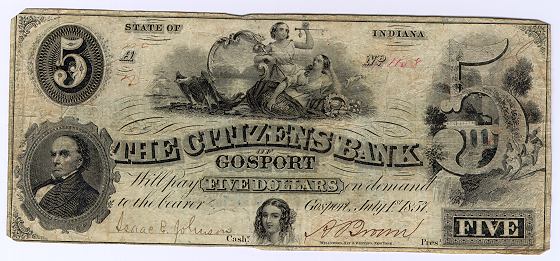
After you are done evaluating the artistic worth of this note, read what it says: "The Citizens Bank of Gosport Will pay Five Dollars on demand to the bearer Gosport, July 1, 1857." This bill was not legal tender, which means that a person could refuse to accept it in payment. If a person took this bill to the bank that issued it, the bank was legally required to give him legal tender, which before the Civil War was gold or silver coin.
Below is the back of this same note. If you look carefully, you will see a trace of the front picture showing through the paper.
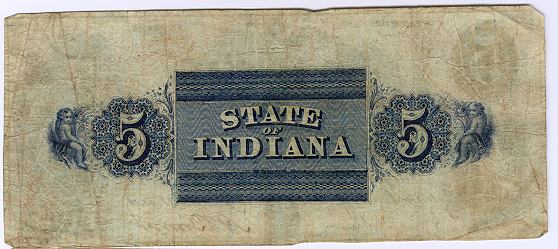
Gosport is a tiny town in southern Indiana that no longer has a bank. Bank notes similar to this one are readily available though coin dealers and are usually called "broken-bank notes." When a bank went out of business in the nineteenth century, all the paper money it had issued became worthless. But people had a reluctance to throw it away—it once had been worth something—so they stuck in the attic. As a result, those banks that went out of business left many notes that are in collections or attics. In contrast, those banks that did not go out of business eventually redeemed the paper money that they issued, so notes of these banks are extremely rare.
Click here to go back to the story of money.
Click here to see more pictures.
 The Federal Reserve Bank of San Francisco has an excellent web site devoted to the history of American Currency. Click here to get a link and a series of questions to help you explore the site.
Copyright Robert Schenk