


Shortages and Surpluses
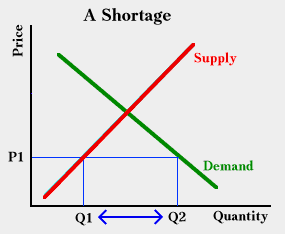
Viewing points on the demand curve as points of buyer equilibrium and points on the supply curve as points of seller equilibrium helps explain how an adjustment process takes place in the supply and demand model. If price is originally P1 in the graph below, only Q1 will be sold even though buyers would like to buy Q2. The difference Q2 - Q1 represents a shortage. The sellers are in equilibrium in this situation because they can sell everything they want to sell at this price, but buyers are not. Some buyers who cannot obtain the product are willing to offer more, and sellers are always willing to accept a higher price. Therefore, the actions of the buyers, as they compete with each other to obtain the amount that is available, drive the price upward in this model toward market equilibrium.
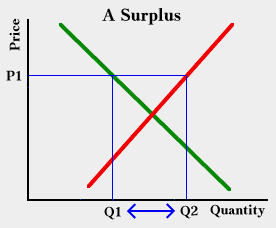
If price is originally at P1 in the picture below, only Q1 will be sold because this is all that buyers will purchase, even though sellers are willing to sell more, Q2. The difference Q2 - Q1 is called a surplus. In this situation the buyers are in equilibrium because they can buy all they want to buy at the going price. However, the sellers are not in equilibrium and will compete among themselves to get rid of the surplus. Some sellers will be willing to offer their product at a lower price. Buyers are always willing to move down the demand curve, so there is a tendency to move downward toward market equilibrium in the picture below.
If left to itself, a supply-and-demand market tends to adjust to the point where the supply and demand curves cross. The price at this intersection is called the market-clearing price. There is, however, the possibility that the existence of lags in the adjustment process may make the adjustment more complex than the previous discussion indicates.
Suppose that the price of cattle feed rises sharply. This event should affect the supply curve of cattle by shifting it to the left. The profitability of cattle production is reduced at each possible price, and some producers will drop out of the industry while others will curtail production. Looking at the curves, we see that price should rise and quantity should drop. However, initially price might drop and quantity might rise, which is the exact opposite of the prediction from the supply and demand graph. The higher costs of feed will encourage farmers to raise fewer cattle, but as part of that cutback, they will temporarily send more cattle to the slaughterhouses. The prediction that supply-demand analysis gives will ultimately be correct, but it will not be correct in the process of adjustment.
More complicated adjustment patterns are possible. Suppose, for example, that higher beef prices shift the demand for pork to the right. Supply and demand analysis says that this should increase pork prices, and at the higher prices, farmers should produce more hogs.
However, hog production takes time, and will only happen if farmers expect the higher prices to continue for a long time. If pork producers do expect the higher prices to last, they may decrease the number of pigs sent to slaughter, further increasing price. A sow can either produce pork or baby pigs, but not both. If farmers expect high prices to last, they will keep their sows for piglet production.
In six months to a year, the baby pigs will have grown enough to go to market. If enough farmers had expected the high prices to last, they may have produced so many pigs that pork prices will now plunge to a level below that which is considered normal. The new, abnormally low price can then influence decisions that will not affect the price for many months. You should see that, once disturbed, a market with long time lags in production may bounce around for years before it finally finds its way back to equilibrium. If such a market is disturbed often enough, its prices and quantities will never come to rest at equilibrium levels.
Microeconomic discussion generally ignores adjustment problems, at least at the introductory level. Microeconomics assumes that markets clear, that is, they are always in equilibrium. Its analysis begins with the assumption that equilibrium has been reached and then asks questions about that equilibrium. However, adjustment problems are very important in macroeconomics. Macroeconomics cannot assume there are no adjustment problems or else it assumes away one of the problems it wants to explain, unemployment. In fact, much of macroeconomics is about the forces that bump an economy away from equilibrium, and why, once it is away, it has problems reaching a new equilibrium.
Copyright Robert Schenk