


Fall of the Phillips Curve
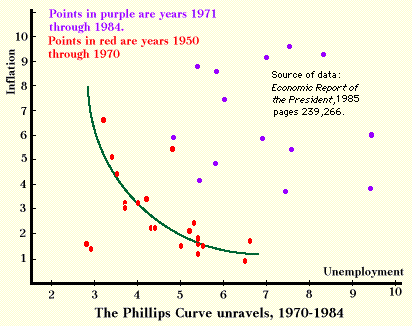
Economists were a bit surprised when Edmund Phelps and Milton Friedman published articles in 1967 and 1968, respectively, arguing that there was no stable trade-off between unemployment and inflation, and that the whole Phillips curve was based on fooling people. Econometricians took the data to their computers to resolve the issue, but their cleverness had little effect on the debate. Instead it was the numbers that the world threw out in the next decade that convinced even the true believers that their original interpretation of the Phillips curve was mistaken. The graph below shows how the years from 1971 through 1984 plot compared to those of the previous twenty years. In 1975, for example, inflation was 9.3 percent but unemployment was a whopping 8.3 percent. Those economists who had accepted the Phillips curve as a tradeoff were baffled by such results, which the newspapers of the time dubbed stagflation. Eventually most economists abandoned the idea that there was a long-run, stable tradeoff that policy makers could exploit.
The explanation of why the Phillips curve is not a stable trade-off can be built on a theory of search. All offers that a person will get are contained between the lines "highest" and "lowest." With this distribution and a path for the reservation wage, there will be some average amount of time spent in search and thus as unemployed.
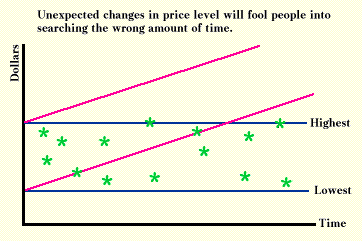
Now suppose that instead of being stable, the distribution of offers gradually rises, or is between the pink lines. If a searcher is unaware that the distribution has tilted upward, he will have no reason to change the path of his reservation wage. With a fixed path for the reservation wage, the searcher will, on the average, find an acceptable offer more quickly. Thus, there will be less unemployment with a rising distribution of offers than there will be with a stationary distribution. On the other hand, if the distribution is falling, then with a given path for the reservation wage, unemployment should be higher than with a stationary distribution.
The above paragraph gives a story that will generate a Phillips curve. The faster wages rise, the more quickly a searcher will find an acceptable offer, and the lower will be unemployment. However, the story assumes that the searcher is unaware that the distribution of offers has tilted. Suppose instead that we assume that he does become aware. Then it is reasonable to assume that he will try to compensate for the tilt by adjusting his reservation wage. If he expects wages to be rising by 10% a year, he will not let the path of his reservation wage drop as rapidly as he would if he expects no inflation. At some rate of expected inflation, he will not let the reservation wage drop at all, but will let it climb.
Once one lets the path of the reservation wage be determined in part by expected inflation (of wages or prices), one undermines the Phillips curve as a long-run trade-off. There will be a trade-off, but it depends on expectations of inflation remaining constant. Once expectations change, the old Phillips curve will shift. This seems to be what happened in the 1970s. Late in the 1960s or early in the 1970s expectations of inflation changed, and so did search behavior. As inflation continued to rise, people began to expect higher and higher rates of inflation. As the short-run Phillips curve shifted upward, positions of high unemployment became compatible with high rates of inflation. As the belief that there was a stable trade-off between unemployment and inflation crumbled, so did the belief that government stabilization policy could solve all macroeconomic problems.
The experience of the 1970s led some economists to assert that the long-run Phillips Curve was a vertical line. If the rate of inflation was held constant, the economy would tend to converge toward this line. Although in the short-run a government could move the economy to the left of this line by increasing inflation, the long-run result would be the same level of unemployment with higher inflation. This long-run level of unemployment to which the economy was supposed to converge, and which macroeconomic policy could not alter, is sometimes called the natural rate of unemployment, though many economists prefer to call the concept the "Non-Accelerating Inflation Rate of Unemployment", or NAIRU. Theories of the natural rate of unemployment represent a rejection of much of the Keynesian message and a return to a faith that prices eventually adjust fully to all disturbances in markets.
We finish with a summary of this and many previous sections.
Copyright Robert Schenk